This post contains affiliate links. As an Amazon Associate, I earn from qualifying purchases at no extra cost to you.
Vintage amplifier specifications can feel like reading a foreign language. You see numbers like “0.07% THD,” “85 dB SNR,” and “damping factor of 50” printed on spec sheets, but what do they actually mean for your listening experience? Whether you’re evaluating a Marantz receiver at a garage sale or comparing two Pioneer models online, understanding these metrics is the difference between making an informed purchase and falling for misleading marketing claims.
The good news is that amplifier specs are decipherable once you know what to look for. With a basic understanding of THD, signal-to-noise ratio, damping factor, and frequency response, you can quickly assess whether a vintage amp is truly restored or just cosmetically cleaned, whether it will drive your speakers properly, and whether it’s actually an upgrade over what you already own. Many experienced techs recommend having a Fluke FLUKE-101 Digital Multimeter on hand when bench testing vintage amplifiers, as it helps verify the basic electrical measurements behind these specs.
This guide walks you through the key specifications you’ll encounter, explains what they mean in practical terms, and shows you exactly how to compare amplifiers using their spec sheets. You’ll learn why a vintage amp with seemingly modest specs can outperform a modern amp with flashier numbers, and how to spot the red flags that indicate a unit needs serious restoration work.
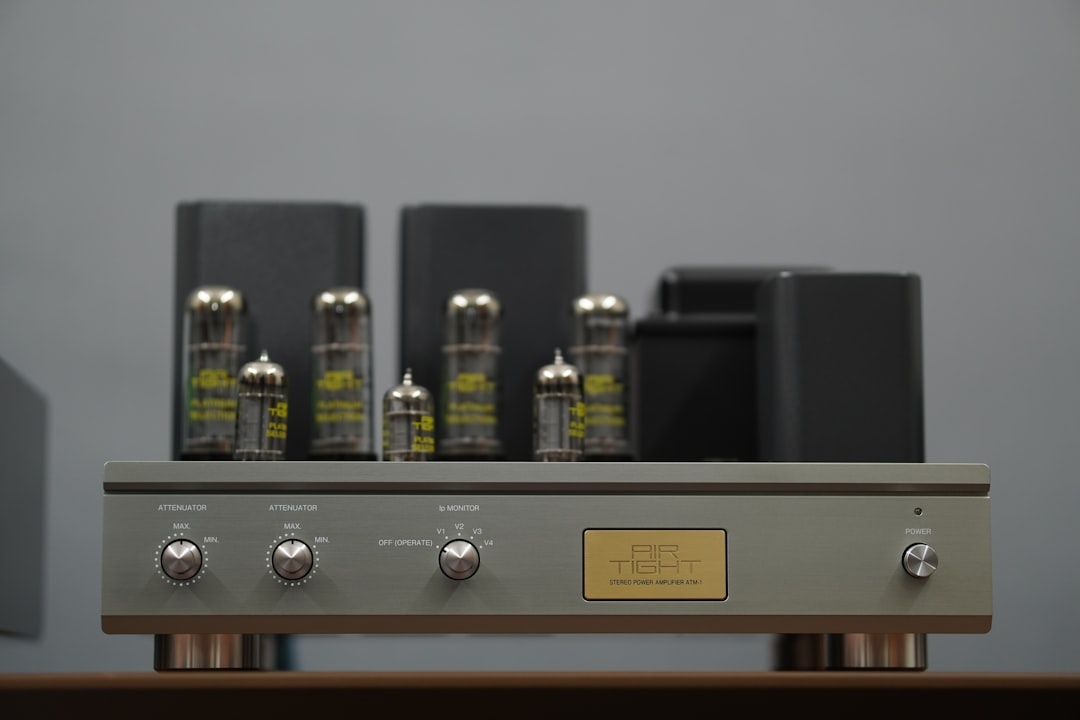
Photo by Tawshif Khan on Unsplash
Total Harmonic Distortion, or THD, measures how much an amplifier deviates from the original signal by adding harmonic content. When an amplifier distorts, it doesn’t just get louder or quieter; it adds new frequencies that weren’t in the original recording. THD is expressed as a percentage, and lower is always better.
To understand THD in context, consider two legendary vintage receivers. The Marantz 2270, a highly sought-after integrated amplifier from the 1970s, was rated at 0.07% THD at rated power. The Pioneer SX-1250, an equally respected competitor, offered similar specs at around 0.08% THD. These numbers might seem practically identical, and from a listening perspective, they are. Both amplifiers produce distortion so low that human ears cannot detect it in any normal listening scenario.
The critical threshold for audible distortion sits somewhere around 0.5% THD for most listeners, and even that assumes careful, critical listening at the limits of your equipment’s capability. At 0.1% THD and below, you’ve entered the region of vanishingly small harmonic content. A 0.07% figure is not seven times better than 0.7%; the improvement is largely irrelevant to actual sound quality. Vintage amplifiers typically measured between 0.05% and 0.2% THD when properly functioning, and this entire range is effectively inaudible to humans in practical listening scenarios.
Where THD becomes important is in two specific contexts. First, if you see THD readings above 1%, the amplifier likely needs repair or has degraded components. Second, you should always check whether the THD specification was measured at the amplifier’s rated power output or at an arbitrary 1 watt. Some manufacturers listed favorable THD numbers measured at 1 watt, where THD is naturally lower, rather than at full power where it climbs. The Vintage Audio Electronics Restoration for Beginners book provides detailed explanations of how these measurements were historically conducted, which helps you interpret older spec sheets where measurement standards varied widely.
Comparing THD between two vintage amplifiers is useful primarily as a tiebreaker when everything else is equal. If two equivalent amplifiers are available and one has documented THD of 0.07% and the other 0.15%, the lower-THD unit represents better engineering and preservation. But never let a slightly lower THD number override other factors like physical condition, availability of service manuals, or the specific output power you need.
Signal-to-Noise Ratio, expressed in decibels (dB), measures the relationship between the loudest clean signal an amplifier can produce and the quietest noise it generates even with no signal present. A higher SNR is better. Typical vintage receivers and integrated amplifiers rated between 80 dB and 100 dB SNR.
Understanding dB is crucial here because the scale is logarithmic, not linear. A 10 dB improvement represents roughly a threefold improvement in signal quality, and a 20 dB improvement represents about a tenfold improvement. So while 85 dB SNR and 95 dB SNR might seem close on paper, that 10 dB difference represents a significantly cleaner amplifier with less background hum and noise.
Most vintage receivers operated in the 85-92 dB SNR range with unweighted measurements. A typical Sansui AU-717 integrated amplifier, for example, offered 85 dB SNR unweighted, which was respectable for the era but represents a noticeable noise floor if you sit quiet in a treated room and listen closely. You would hear some background hiss, particularly with higher-efficiency speakers or when playing quieter classical recordings.
Here’s where measurement method matters enormously. A-weighted SNR, which weights the measurement toward frequencies the human ear is most sensitive to, typically shows 5-10 dB higher than unweighted SNR on the same amplifier. So if you see “95 dB SNR A-weighted” on a spec sheet, the actual unweighted noise floor might be closer to 85 dB. Always check whether the manufacturer specified A-weighted or unweighted SNR, and if that information is missing, assume unweighted.
Modern reproductions and restorations sometimes improve SNR beyond original specs through careful power supply upgrades, noise filtering, and better grounding practices. If you’re evaluating a vintage amplifier for purchase, SNR matters most if you use highly sensitive speakers (90 dB sensitivity or higher), listen in very quiet rooms, or prefer minimal hum and hiss during quiet passages. Most vintage amps with SNR above 85 dB perform excellently in typical home listening environments.
Damping factor is a specification that confuses many vintage audio enthusiasts because the name doesn’t intuitively convey what it measures. Damping factor expresses how much the amplifier’s internal impedance resists the speaker’s back-emf (back electromotive force), which affects how tightly the amplifier controls the speaker cone’s movement, particularly in the bass frequencies.
The formula for damping factor is straightforward: speaker impedance divided by the amplifier’s output impedance. A vintage amplifier with 0.1 ohm output impedance driving an 8-ohm speaker would have a damping factor of 80. Most vintage receivers and integrated amplifiers offered damping factors between 20 and 80, with 40-50 being typical for quality designs.
What does this mean in practical listening? A higher damping factor (lower output impedance) provides tighter, more controlled bass response with quicker transient response. The woofer cannot overshoot and ring, resulting in cleaner bass definition. Conversely, a lower damping factor allows the speaker to resonate more freely, which some listeners prefer for certain music and can add a slight boost to bass impact.
However, the relationship between damping factor and speaker control isn’t as simple as “higher is always better.” Damping factor’s effect depends heavily on your speakers’ impedance curve and the speaker cable you use. A vintage amp with 50 damping factor driving vintage JBL L100s with relatively flat impedance will sound dramatically different from the same amp driving modern speakers with impedance dips below 4 ohms. Additionally, the cable resistance between amplifier and speaker effectively reduces damping factor by the ratio of cable resistance to speaker impedance. With cheap, thin speaker cable, you might lose half your damping factor before the signal even reaches the driver.
If you’re evaluating a vintage amplifier, damping factor rarely represents a deal-breaker unless it’s extremely low (under 10) or extremely high (over 200, which suggests different measurement conventions). Most matching between amp and speaker works within the 20-80 damping factor range. Tools like the Seismic Audio Cable Tester can help verify your speaker cable resistance and thus confirm the effective damping factor you’re actually achieving.
Frequency response describes which frequencies an amplifier can amplify and pass to your speakers. The standard specification “20 Hz to 20 kHz, +/- 1 dB” means the amplifier reproduces all frequencies in the human hearing range with minimal coloration, the +/- 1 dB representing the maximum allowable variation in gain across that range.
The critical nuance in frequency response specs lies in the tolerance specification: +/- 1 dB versus +/- 3 dB. A +/- 1 dB specification is quite strict and indicates careful circuit design. A +/- 3 dB specification is more lenient; it allows the amplifier to be down by 3 dB at certain frequencies, which listeners can sometimes perceive as a slight coloration or mellowing of certain frequency ranges. Most vintage amplifiers listed +/- 3 dB frequency response, with premium models like certain Marantz units advertising +/- 1 dB.
For phono stages integrated into vintage receivers, frequency response specification becomes even more important because of RIAA equalization. The RIAA curve, adopted as standard for vinyl records, requires specific equalization during playback to restore flat frequency response. If a phono stage’s frequency response deviates significantly from the RIAA standard, the result is bass emphasis, treble rolloff, or both, making vinyl records sound colored and unnatural.
Bandwidth limitations in vintage amplifiers rarely cause problems in practice. A properly functioning amplifier with 20 Hz to 20 kHz response handles all musical content with no restrictions. However, if you’re evaluating an older unit that lists narrower bandwidth (say, 50 Hz to 15 kHz), expect noticeable loss of deep bass and extreme treble detail. This becomes relevant when pairing with subwoofers or when listening to acoustic bass and cymbals, where that extended bandwidth matters to the overall presentation.
When you encounter a vintage amplifier spec sheet, whether in printed documentation or a digital scan, follow this systematic approach to extract useful information:
Find the original spec sheet. Visit resources like Vinyl Engine’s manual library (vinylengine.com/library), manufacturer archives, or contact collector communities. Photocopied or transcribed specs can contain errors. Original documentation, preferably from the manufacturer, provides the most accurate information.
Check the power output at rated impedance. Look for “power output” or “rated power” measured in watts at your speaker impedance (typically 8 ohms). Ignore peak power specifications or “music power” claims; focus on RMS or continuous power. This number tells you whether the amplifier can drive your speakers to desired volume levels.
Verify THD measurement conditions. Confirm whether THD is measured at rated power or at 1 watt, and note the frequency at which it was measured (typically 1 kHz). THD measured at 1 kHz, 1 watt will be lower than the same amp measured at rated power and 20 kHz, so compare apples to apples.
Check SNR measurement method. Determine whether SNR is stated as A-weighted or unweighted. Unweighted SNR is more conservative and realistic. If the spec sheet doesn’t specify, assume unweighted, and subtract 5-10 dB mentally to account for conservative assumption.
Compare damping factor to your speaker impedance. Multiply your speakers’ impedance by the listed damping factor to estimate output impedance. Confirm this aligns with your speaker cables’ expectations. Cross-reference with speaker impedance curve information if available.
Note bandwidth limits and tolerance. Flag any frequency response limitations outside 20 Hz to 20 kHz, and note whether the tolerance is +/-1 dB or +/-3 dB. Tolerance directly affects perceived coloration.
These six steps provide a framework for rapid assessment. By working through them systematically, you’ll quickly distinguish between well-engineered vintage amplifiers and those with hidden limitations.
Even experienced enthusiasts occasionally stumble when interpreting vintage amplifier specifications. Here are the most frequent errors and how to avoid them.
Comparing RMS power to peak power is the most common mistake. Manufacturers sometimes listed “peak power” or “music power” instead of continuous RMS power, and these numbers can be double or triple the actual RMS output. Always look for “RMS,” “continuous,” or “rated power” in the spec. If the documentation is ambiguous, calculate it yourself using Ohm’s law with measured voltage and impedance data.
Ignoring measurement conditions leads to false comparisons. Two amplifiers might both claim 0.1% THD, but one measured at 1 watt while the other measured at rated power and 20 kHz. These are incomparable. Always note the frequency, power level, and load impedance conditions for every specification you’re comparing.
Trusting “specs at rated power only” without checking performance elsewhere creates problems when real-world listening demands matter. An amplifier might measure beautifully at rated power but significantly degrade at lower volumes or different frequencies. Ask for or seek out measurements at multiple power levels and frequencies for comprehensive evaluation.
Misunderstanding damping factor in relation to speaker impedance causes incorrect amplifier-speaker matching. A damping factor of 50 isn’t universally “better”; it depends on speaker impedance and cable resistance. You must know your speakers’ impedance curve and cable gauge to evaluate damping factor meaningfully.
Overlooking measurement date and era represents another frequent mistake. Specifications from the 1970s used different measurement standards than modern testing. An amplifier spec sheet from 1976 might not directly compare to one from 1982 or 1995. When possible, seek out comparative reviews from contemporary sources to understand how specs translated to actual listening performance in their original context.
Q: Is a higher damping factor always better?
A: No, damping factor isn’t universally “more is better.” While higher damping factor (lower output impedance) provides tighter bass control and quicker transient response, the audible effect depends on your specific speakers and listening preferences. Damping factor of 50 versus 20 produces noticeable differences with some speaker designs, particularly those with loose or resonant woofers, but becomes inaudible with speakers designed to work well across a wide range of damping factors. Additionally, your speaker cable resistance affects effective damping factor; cheap thin cables can reduce damping factor by half before the signal even reaches your drivers. Some listeners actually prefer the slightly looser bass and enhanced impact that comes from lower damping factors, particularly when listening to jazz or pop music where bass punch matters more than surgical precision. The real-world difference at typical listening volumes is subtle and highly dependent on your specific gear combination. Rather than chasing the highest number, match damping factor appropriately to your speakers’ design and cable quality.
Q: How much does THD actually matter below 0.1%?
A: Once you’re below 0.1% THD, the difference becomes essentially irrelevant for human perception in all practical listening scenarios. Hearing research demonstrates that humans cannot detect distortion below 0.5% in normal listening, and only with careful critical listening at high volumes can most people detect distortion above 0.5%. A vintage amplifier rated at 0.05% THD versus 0.08% THD sounds identical to any listener. What matters is that the amplifier measures below that 0.5% threshold and maintains stable performance across frequency ranges and power levels. Instead of obsessing over the difference between 0.05% and 0.10% THD, focus on whether the amplifier has been properly restored, uses quality output tubes or output transistors, and benefits from a clean power supply. An amplifier measuring 0.12% THD but recently recapped and aligned will sound superior to one measuring 0.07% THD but harboring electrolytic capacitors that are forty years old and degrading. Prioritize overall amplifier condition and maintenance history over incremental THD improvements below the audible threshold.
Q: Why do vintage amps often outperform their specs in listening tests?
A: Vintage amplifiers frequently sound better than their numbers suggest because specifications measure only certain narrow aspects of performance, while listening encompasses the entire system behavior, component quality, and circuit topology. An amplifier measuring higher THD than a modern design might employ a tube output stage with soft, musical distortion characteristics that listeners perceive as less fatiguing than the sharper, harder distortion characteristic of some solid-state designs. Additionally, many vintage amplifiers feature transformer-coupled outputs that provide subtle high-frequency filtering, reducing harshness from digital sources and aggressive recordings. The presence of real analog circuitry without switched-mode power supplies means vintage amps often exhibit lower susceptibility to noise from switching frequencies. Specifications also don’t capture the subjective experience of build quality, knob feel, and visual presentation, which influence how much we enjoy using equipment. Measurement data captures only what engineers thought to measure at the time; it cannot quantify factors like synergy with specific loudspeaker designs, immunity to room acoustics, or the psychological pleasure of operating a beautifully designed device. This is why a 1975 Marantz 2270 with modest measured specs often outperforms far more powerful modern amplifiers in actual listening, particularly when paired with vintage loudspeakers designed to work optimally with such equipment.
Vintage amplifier specifications provide a useful first filter when evaluating equipment, but they’re never the complete story. Understanding THD, SNR, damping factor, and frequency response allows you to spot red flags, compare similar models intelligently, and distinguish between genuine restoration and cosmetic touch-up. Yet the best amplifier remains the one that sounds good in your room with your speakers and your music collection.
Use these specifications as one tool in your decision-making process. Cross-reference them with physical inspection, listening tests when possible, and advice from the collector community. A seemingly modest-spec vintage amp that’s been properly restored and maintained will deliver more pleasure than a high-spec unit hobbled by neglect and aging components.
Bookmark this guide or share it with a friend evaluating their first vintage amplifier purchase.
Interested in learning more about vintage amplifiers? Read our comprehensive Vintage Integrated Amplifier Buying Guide for practical advice on selecting your first quality amplifier, or dive deeper into maintenance with our How to Match Impedance Between Amps and Speakers guide.
For more technical depth on audio measurement standards, consult the Audio Engineering Society standards documentation, which details the measurement protocols that vintage manufacturers sometimes employed. The Vinyl Engine service manual library archives thousands of original spec sheets and service documentation that provide context for comparing vintage equipment.