How to Match Impedance Between Amps and Speakers
If you’ve ever connected a vintage receiver to a pair of speakers and heard something buzzy, strained, or flat, or if you’ve read a spec sheet that says “4 to 16 ohms” and wondered what that actually means for your setup. Impedance matching is the issue worth understanding. It’s not complicated once the basic concept clicks, but it’s one of the details most newcomers to vintage HiFi overlook until something goes wrong.
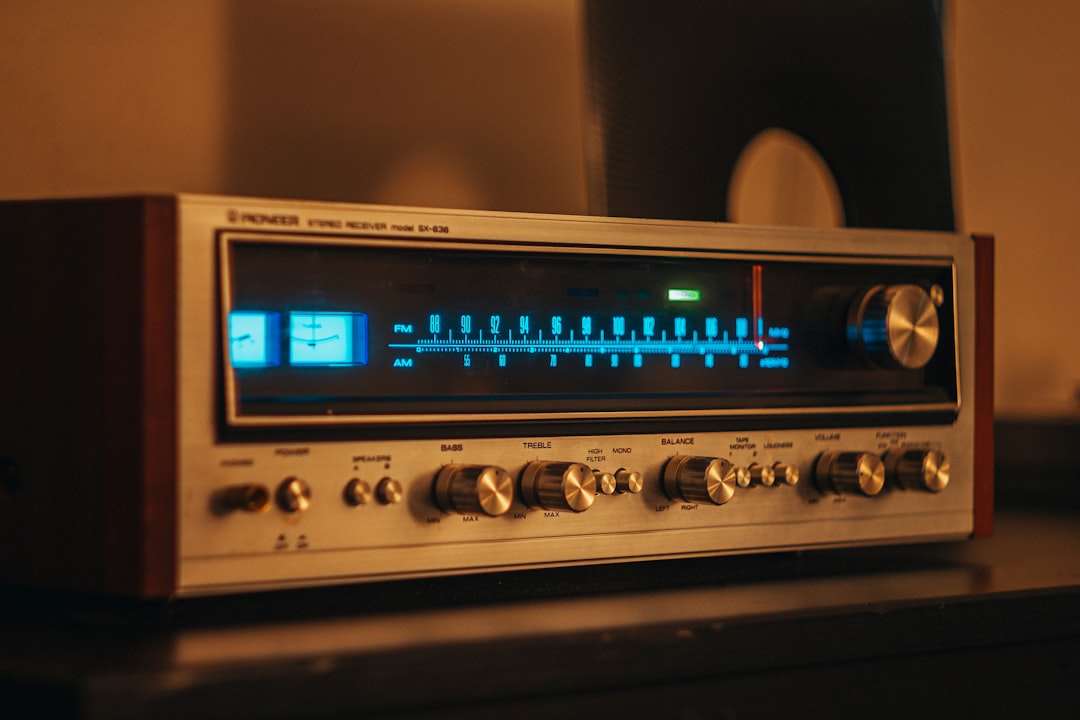
Photo by James Krudop on Unsplash
Safety note: Vintage amplifiers and receivers contain capacitors that can hold dangerous charge even when unplugged. If your troubleshooting requires opening a chassis or touching internal components, discharge all capacitors before proceeding and treat any uninsulated terminal as potentially live. If you’re working with tube equipment, the voltages on the output transformer and plate resistors can be lethal. When in doubt, have the work done by a qualified technician.
What Speaker Impedance Actually Means
Impedance is the AC resistance a speaker presents to an amplifier’s output. It’s measured in ohms and it varies with frequency, so the single number on a spec sheet (“8 ohms,” “4 ohms,” “6 ohms”) is a nominal figure, not a constant value across the audio band.
A real speaker’s impedance curve dips and rises as frequency changes. A speaker rated at 8 ohms nominal might drop to 5 or 6 ohms at certain frequencies and rise above 20 ohms at others. This is normal. The nominal rating gives you a useful approximation for matching purposes, but it’s worth knowing that the minimum impedance point (not the nominal) is what stresses your amplifier most.
The physical reason for this: a speaker is a motor. The voice coil is a conductor moving through a magnetic field. At resonance, the voice coil’s back-EMF (electromotive force) pushes against the amplifier, raising apparent impedance. Below resonance and above the crossover point, the reactive load from capacitors and inductors in the crossover network can pull impedance down significantly.
When we talk about impedance matching, what we’re really asking is: is the speaker’s impedance range compatible with what this amplifier was designed to drive?
How Amplifiers Specify Impedance Compatibility
Most vintage receivers and integrated amplifiers will show a spec like “Suitable for 4-16 ohm speakers” or “Minimum load: 8 ohms.” Some label it on the back panel near the speaker terminals. Others require checking the owner’s manual or the service manual, both of which are usually findable on sites like Vinyl Engine or HiFi Engine.
What those ratings actually define is the output stage’s safe operating window. The amplifier’s output transistors (or output tubes, for tube amps) are sized for a particular current demand. Ohm’s law tells you that lower impedance means higher current for the same voltage output. An amplifier rated for 8 ohm minimum that’s asked to drive a 4 ohm speaker will need to double its current output to produce the same power. That stresses the output stage thermally and can exceed the transistors’ safe operating area.
Tube amplifiers behave differently. Their output transformers are wound for specific impedance ratios between the plate circuit and the speaker terminals. Most vintage tube amps have a tap selector on the back (4, 8, 16 ohm). Using the wrong tap doesn’t instantly destroy anything, but it degrades damping factor and harmonic distortion, and over time it stresses the transformer and output tubes unevenly.
Solid-state vintage receivers from the 1970s and 1980s (the Pioneers, Marantzes, and Sansuis most people are working with) were generally designed for 8 ohm loads but usually tolerate 4 ohms if the output stage is in good condition. Receivers that run hot with an 8 ohm load should never be pushed to 4 ohms without confirming the thermal protection is working and the output transistors have been tested.
What Happens When Impedance Doesn’t Match
The three scenarios most likely to come up in a vintage HiFi context are: speaker impedance too low, speaker impedance in range, and speaker impedance too high. Each has different symptoms and different risks.
| Scenario | Typical Cause | Audible Symptom | Risk to Equipment |
|---|---|---|---|
| Speaker impedance too low | 4 ohm speakers on amp rated 8 ohm min | Amp runs hot, sound compresses at volume | Output transistor or fuse failure; thermal shutdown |
| Speaker impedance well-matched | 8 ohm speakers on amp rated 4-16 ohm | Full dynamic range, clean bass, stable imaging | Minimal; normal wear |
| Speaker impedance too high | 16 ohm speakers on amp rated 4-8 ohm | Output stage underloaded, thin bass | Generally safe but poor damping factor |
| Multiple pairs wired in parallel | Two 8 ohm pairs = 4 ohm load | Same as too-low impedance above | Same failure mode (often overlooked) |
The most common real-world problem we see is people running two pairs of speakers in parallel off a vintage receiver without accounting for the combined impedance load. Two 8 ohm pairs in parallel present 4 ohms to the amp. On a receiver rated for 8 ohm minimum, that’s outside spec. The amp will play but run hot, and the output stage will age faster.
The second common problem is impedance mismatch on tube amps. A vintage integrated running 6L6 or EL34 output tubes has a transformer wound for a specific load. Connecting speakers that are well outside the tap value (e.g., 4 ohm speakers on the 16 ohm tap) increases distortion noticeably and can damage the transformer over time.
How to Measure Your Speakers’ Actual Impedance
The spec on a speaker’s back panel or in a vintage data sheet gives you the nominal impedance, but it does not tell you the minimum. If you have an impedance-measuring device, or even a standard digital multimeter, you can get a useful approximation.
With a multimeter (DC resistance method):
- Disconnect the speaker from the amplifier completely.
- Set your multimeter to the 200 ohm DC resistance range.
- Touch the probes to the speaker’s positive and negative terminals.
- Read the DC resistance of the voice coil.
DC resistance (DCR) is always lower than nominal impedance, typically 80-85% of the nominal value. A speaker reading 6.5 ohms on DC resistance is almost certainly an 8 ohm nominal speaker. A reading of 3.2-3.5 ohms means a 4 ohm speaker. A reading under 3 ohms is a 2 ohm or very low impedance design not suited to most vintage receivers.
In our experience testing vintage drivers, this method is reliable enough for a quick sanity check. It won’t show you the minimum impedance curve dip, but it confirms the nominal class (4 ohm vs. 8 ohm vs. 16 ohm) with confidence.
With a dedicated impedance tester:
Instruments like the allsun EM480B measure AC impedance at a test frequency, giving a more accurate picture than DC resistance. For most vintage HiFi work, the multimeter method is sufficient, but if you’re recapping crossovers or building a speaker system from drivers, a proper impedance measurement tells you much more.
Checking the spec sheet:
For vintage speakers made by Jensen, JBL, Klipsch, Altec, or most of the major 1970s Japanese brands, the spec sheets are usually findable online and list both nominal and minimum impedance. Audiokarma and Vinyl Engine both have searchable manuals databases. Minimum impedance below 3.2 ohms in a vintage driver is unusual and should be flagged before pairing with any vintage solid-state receiver.
For a deeper technical explanation of how speaker impedance curves behave across frequency, Audioholics’ speaker impedance guide is one of the best free resources available.
Practical Impedance Matching: Step-by-Step for Common Vintage Setups
Follow this sequence any time you’re pairing a vintage amp or receiver with speakers you haven’t used before.
Step 1: Identify your amplifier’s minimum impedance rating. Check the back panel near the speaker terminals. If it’s not printed there, find the spec in the owner’s manual (HiFi Engine has most). Note whether the spec is a minimum (e.g., “min 4 ohms”) or a range (e.g., “4-16 ohms”). If you’re working with a tube integrated, note the output tap options, usually labeled A, B, or by ohm value.
Step 2: Identify your speakers’ nominal impedance. Check the back of the speaker cabinet, the driver itself, or the original spec sheet. When information conflicts, use the DC resistance method above to confirm. As noted, multiply your DCR reading by approximately 1.2 to estimate the nominal impedance.
Step 3: Check the combination against the table above. If your speakers are within the amp’s rated range, proceed. If the speakers are below the amp’s minimum, decide whether the application warrants a speaker selector (see below) or finding speakers better suited to the amp.
Step 4: For tube amps, select the correct output tap. Match the tap to your speaker’s nominal impedance. If your speaker is 6 ohms nominal and you have 4 and 8 ohm taps, the 8 ohm tap is the better choice. It slightly increases distortion compared to a perfect match but keeps transformer stress lower than a severe mismatch.
Step 5: If running multiple speaker pairs, calculate parallel impedance. Two identical speakers in parallel: divide nominal impedance by 2. Two 8 ohm pairs = 4 ohm load. Three 8 ohm pairs = 2.67 ohm load, which is below the safe range for most vintage receivers. If you need to run multiple pairs, use a speaker selector with built-in impedance protection (discussed below) rather than wiring directly to the amplifier’s binding posts.
For more on running multiple speakers and bridging configurations, our guide on how to biamp speakers with a vintage receiver covers the wiring logic in detail.
Impedance Matching Solutions for Difficult Combinations
Sometimes the speakers you want to use don’t sit cleanly within an amplifier’s rated range. A few solutions exist, ranging from simple hardware to component-level fixes.
Speaker selectors with impedance protection
A speaker selector switch with built-in impedance protection uses resistive networks to prevent the total load from dropping below a safe threshold regardless of how many pairs are connected. These are the cleanest solution when running two or more pairs off a vintage receiver. The Monoprice SS-Pro 12 Speaker Selector is a well-regarded option that handles up to 12 pairs and includes adjustable impedance protection per zone.
The tradeoff is a small insertion loss: the resistive network absorbs some power, so you will notice the amp working harder at the same volume. For casual multiroom listening, this is acceptable. For critical listening in a single room, it is better to match impedance through driver or speaker selection than to add a passive network in the signal path.
Impedance matching transformers
Line-matching transformers like the Bogen WMT1A can step impedance between incompatible source and load values. These are used most often in commercial or distributed audio contexts, and in vintage home HiFi they’re relevant primarily for 70V distributed speaker systems or for adapting very unusual speaker loads. For typical 4-16 ohm home speakers and receivers, a transformer is overkill and adds sonic coloration. It is a last resort, not a first step.
Series resistors (DIY approach)
Adding a resistor in series with a low-impedance speaker raises the total load impedance seen by the amplifier. A 4 ohm speaker with a 4 ohm series resistor presents an 8 ohm load to the amp. The resistor absorbs power proportional to its value as a fraction of the total impedance. In this example, 50% of the power goes to heat in the resistor rather than to the speaker. This is inefficient and most audibly affects bass damping. It works as a short-term fix to protect an output stage, but it is not a long-term listening solution.
Replacing output transistors for a wider operating range
For vintage receivers where the original transistors are marginal for 4 ohm loads, upgrading to more modern, higher-power complements rated for lower collector-emitter saturation voltage can meaningfully widen the safe load range. This is a bench-level repair. If you’re rebuilding a receiver and know you’ll be driving 4 ohm speakers, specifying output transistors with appropriate power dissipation ratings upfront is the cleanest path. See our guide on vintage receiver buying and evaluation for context on output stage quality across different makes.
Common Mistakes and How to Avoid Them
Assuming all speaker terminals are the same impedance. Vintage speaker systems with multiple binding posts (designed for biamping or biwiring) present different impedances on the high-frequency and low-frequency terminals. Connecting a single-channel amp to only the tweeter section’s terminals, or only the woofer section’s, is not the same as driving the full crossover load. Always connect both terminal pairs in a standard passive biamp if you’re not running separate amplification per section.
Ignoring minimum impedance dips in crossovers. A speaker with a nominally 8 ohm crossover can dip to 3 ohms at a specific frequency due to capacitor values in the passive network. This is especially common in certain vintage Advent, Celestion, and Infinity speaker designs. If a speaker has a reputation for “being a tough load” in forum discussions, verify minimum impedance before pairing it with a receiver you care about.
Using the 16 ohm tap on a tube amp for 8 ohm speakers. This is one of the more common errors we see on the bench. It reduces damping factor and increases distortion noticeably in the bass range. Always use the closest available tap.
Wiring speaker pairs in parallel without checking. This mistake is especially common with setups that use A/B speaker switching. Most receivers with A/B switching do not sum the loads internally; they connect both pairs to the same output simultaneously when both are selected. Running A and B simultaneously on 8 ohm speakers presents a 4 ohm load. Always check whether your receiver’s A+B mode sums the loads.
Trusting the amp spec alone without checking output stage condition. A vintage receiver spec sheet may say “4-16 ohms compatible,” but if the output transistors are original and aging, the actual safe low-impedance headroom may be reduced. In our experience testing units from the late 1970s, original output transistors that measure within spec at room temperature sometimes fail under sustained low-impedance load at working temperature. If you’re driving 4 ohm speakers from a vintage receiver, make sure the output stage has been inspected or recapped.
FAQ
Can I damage my vintage amp by using 4 ohm speakers if the spec says 8 ohms minimum?
Yes, it’s a real risk, particularly under sustained high-volume use. The output stage will run hotter than designed, and if the thermal protection is marginal (common in 40-year-old units), you may trip the protection circuit or damage output transistors. Using 4 ohm speakers at moderate volumes on an otherwise healthy 8 ohm minimum receiver usually isn’t immediately catastrophic, but it shortens component life. If the speakers you want are 4 ohms, use a receiver that’s rated for 4 ohm loads, or add an impedance protection device in the signal path.
Do I need to match impedance exactly, or is “close enough” acceptable?
For solid-state receivers, close is fine, within the rated window is all you need. An 8 ohm amp running 6 ohm nominal speakers is no problem. The issue arises when you go below the minimum, not when you’re anywhere within the rated range. For tube amps, the tap should ideally match the speaker’s nominal impedance, but one step away (8 ohm tap on 6 ohm speakers, or 4 ohm tap on 6 ohm speakers) introduces modest distortion that most listeners won’t notice at normal listening levels.
What’s the difference between impedance and sensitivity, and why does it matter?
Sensitivity (measured in dB/W/m) tells you how loud a speaker plays for a given input power. Impedance determines how much current the amplifier has to supply to deliver that power. High-sensitivity, high-impedance speakers (like many vintage horn-loaded designs) are very easy to drive and work well with low-powered tube amps. Low-sensitivity, low-impedance speakers demand both higher current and higher power, which is why they’re best paired with robust solid-state designs. When shopping for speakers to pair with a vintage integrated or receiver, look at both specs together, not just impedance in isolation.
My vintage receiver has separate A and B speaker terminals. Is it safe to use both at the same time?
It depends on the receiver. Many 1970s receivers with A/B switching connect both pairs simultaneously when both are selected, halving the total impedance. Some higher-end units include relay-based switching that prevents true simultaneous connection. Check your service manual or verify with a continuity test: if binding posts A and B share a common output terminal internally, running both simultaneously sums the loads. On most vintage units, the safe approach is to use A or B, not both, unless you know the design handles it.
How do I know if my vintage amp is running too hot for its load?
Touch the heatsink (not internal components) after 20-30 minutes of moderate-volume listening. It should be warm but not so hot you can’t hold your hand on it. If you can’t maintain contact for 5 seconds, the amp is running too warm. Also check whether thermal protection is triggering (sudden volume drops or muting). This is a clear sign the output stage is being pushed hard. A receiver that runs cool with 8 ohm speakers but hot with your 4 ohm speakers is confirming the impedance mismatch.
Impedance matching is not about perfect numbers. It is about staying within the safe operating range of your amp’s output stage and selecting the right transformer tap if you’re running tubes. For most vintage solid-state setups, the practical rule is: confirm your speakers’ nominal impedance is at or above the amp’s rated minimum, do not run multiple pairs in parallel without accounting for the combined load, and do not ignore sustained heat as a warning sign.
If you’re building a system from scratch, see our guide on vintage receivers and what to look for on the used market for more on how output stage design affects pairing flexibility.
Bookmark this page as a reference the next time you’re swapping speakers or evaluating a new-to-you receiver. It covers the key scenarios you’ll run into in a vintage HiFi context.